Articles
Ruli vs. Legora: Which Legal AI Platform Is Right for Your In-House Team?
Web Format

Not all legal AI is built for the same job. Some tools help individual lawyers answer questions faster. A few are built to transform how an entire in-house legal team operates, from the daily contract queue to the regulatory change no one saw coming to the question the CFO asks an hour before a board meeting.
Ruli is built for the second job: one platform that runs research, redlining, regulatory monitoring, and due diligence — all grounded in your playbooks and institutional knowledge. This guide is honest about where Legora is strong, where in-house teams tend to outgrow it, and why legal teams choose Ruli for the full scope of your work, not just one slice of it.
How to evaluate a legal AI platform for your in-house team
Before diving into the comparison, here are five questions worth asking before you buy any legal AI:
Does it cover the full job, not just one slice? In-house legal teams live in contracts, research, regulatory change, and business operations — not one workflow. A tool that only does one forces you back to manual work or other vendors.
Was it built for in-house teams, or adopted from a Big Law tool? Firms manage many clients, so their tools optimize for managing many clients’ matters. In-house teams typically manage one company’s risk, continuously — which means you need a system that knows your company deeply: your playbooks, your risk posture, and your precedent. Tools adopted from law firms carry assumptions and workflows that don’t fit the in-house role.
Does the output match your team’s voice and standards? Generic drafts create work. Effective legal AI’s output should carry your redlining style and your positions, ready to send — not an output you have to verify and rewrite before it can leave the building.
Can you measure what it saves you? If a vendor can’t help you quantify impact — hours saved, outside counsel spend avoided, response time improved — it’s hard to justify to your CFO. Look for a vendor whose pilot produces the numbers from day one.
Does the team behind the AI understand legal risk? A confident wrong answer is worse than none. A platform built by lawyers and engineers who know the cost of a bad redline or a missed regulatory change is not the same as a general chatbot with a legal skin.
Who Legora is designed for
Legora was founded in Stockholm in 2023 for large transactional law firms running high-volume document review, M&A diligence, and multi-jurisdictional deals. The platform has since expanded toward in-house teams, but the core design still reflects its firm-side, transactional origin: pricing starts at a 10-seat minimum, and the practice areas it’s built around are M&A and litigation.
Where Legora creates value
AI contract redlining inside Microsoft Word, checking every clause against your playbook and flagging risks on MSAs and vendor agreements.
Playbooks let teams set their negotiation positions once and apply them on every agreement.
Compares to Market benchmarks contract terms against real-time data spanning 80+ countries and hundreds of industries.
Drafting pulls from a team’s own precedents and preferred positions so every new vendor contract starts where the last good one left off, not from a blank page.
AI agent that plans and executes multi-document projects end-to-end, covering data room reviews, financing documents, disclosure schedules, and employment packages.
Where organizations tend to hit limits with Legora
Legora is built for transactional legal work (M&A and due diligence, and multi-document projects). Teams whose daily work extends to regulatory monitoring, compliance, employment matters, or general legal research will find those workflows underserved.
Contracts don’t live in a searchable system of record. Legora tracks a single matter as it moves, not a persistent, company-wide repository. There’s no equivalent to grouping a master agreement with its amendments and SOWs as one contract family.
Pricing is built for enterprise legal budgets, with a 10-seat minimum.
How Ruli approaches the same problem
Ruli runs contract review and redlining, alongside legal research, regulatory monitoring, and repository search through one system, so the same tool handles work across commercial contracts, employment questions, compliance checks, and monitoring alerts. A team doesn’t need a second platform for the work that falls outside contracts.
Every document becomes part of a living knowledge base, not a folder: Contract Lens turns stored agreements into something the team can question directly. Ask in plain language, get the answer back immediately, instead of opening documents one by one to find it.
No seat minimum, and no enterprise price tag to match it: Ruli scales to the size of the team actually doing the work, without a minimum headcount required to get in the door.
Side-by-side comparison
Capability | Ruli | Legora |
|---|---|---|
AI legal assistant (chat interface) | Yes (Assistant) | Yes |
Word plugin for in-context redlining | Yes (Word Extension) | Yes |
Company Profile, personalization of risk tolerance and responses | Yes | No |
Playbook creation and review | Yes | Yes |
Regulatory and contract monitoring | Yes (Monitor) | Yes |
Indexed US, UK, and EU legal sources | Yes — Ruli Legal Database | Yes |
Smart contract repository and search | Yes (Contract Lens) | No |
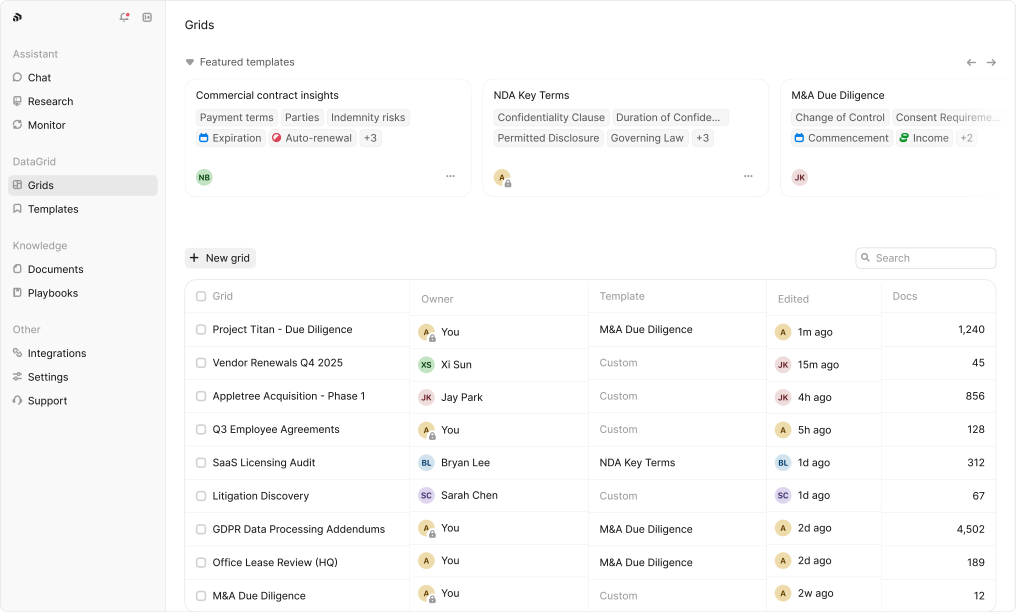
Tabular document review at scale (M&A / due diligence) | Yes (DataGrid) — supports up to 10K documents per analysis | Yes |
Structured two-week onboarding | Yes | No |
Team-level usage analytics for legal tasks | Yes | Yes |
ROI measurement built into pilot process | Yes | No |
When is Ruli a better fit than Legora?
Your daily scope extends beyond high-volume document review. Legora’s lanes are M&A, litigation, banking, tax, and insurance, built for the workflows of large transactional practices. Teams whose day spans commercial contracts, employment matters, regulatory monitoring, and business support will find parts of that scope underserved.
The team needs a tool built for in-house legal from the ground up, not a law firm platform extended to cover in-house work. Every product decision at Ruli is made for one company managing its own risk continuously, not a firm managing many clients’ matters. That shows up in what gets built first and how it works, not just in the marketing.
The team needs its contracts to live in an actual system of record, not a document search tool. Ruli auto-groups a master agreement with its amendments and SOWs into one contract family and single source of truth.
The team needs a vendor who builds the business case during the pilot, not a 10-seat minimum like Legora. Zahreen Ghaznavi’s team at Newsweek tracked 754 hours saved on a single M&A project.
Regulatory changes and contract obligations need to be flagged before they become problems, not after.
Hands-on support matters beyond the sale. Nilay Choksi, GC at Worksport: “It wasn’t just to make the sale, but also to keep the customer happy.”
When Legora may be the right fit
Legora is worth a serious look with significant European exposure, where multi-language matters and EU data residency are first-class requirements.
The bottom line
Legora is a genuinely capable platform for the legal team that lives in high-volume document review and where European reach is first-class. But the product was built for large transactional law firms first, and it shows. The customer base is concentrated among large European law firms, and the daily scope it covers — M&A, litigation, banking, tax, and insurance — maps to firm-side workflows more than the range of work landing on a GC’s desk.
Ruli is built for the legal team that needs one platform across the full scope of in-house work — contracts, research, regulatory monitoring, and business support — with a support team that stays involved after the sale and a pilot process designed to produce numbers your CFO can act on.
“If I could not use Ruli tomorrow, you’re going to see us consulting outside counsel more. That comfortableness we have with the tool would disappear.” — Zahreen Ghaznavi, General Counsel at Newsweek
For a lean team at a global media company, that’s what the tool becoming indispensable actually looks like.
See how Ruli works across your team’s actual workflows, starting with the work already on your desk.
Related resources

Guidebooks
The Business Case for Legal AI
The four ways in-house teams measure the value of legal AI, backed by real numbers from real customers.
1 min read
Download

Guidebooks
Procurement to Proof
Scaling legal AI for impact — and getting credit for it
1 min read
Download

Guidebooks
Defensible by Design
A practical system for safely scaling AI across the in-house legal function.
1 min read
Download