Articles
Ruli vs. GC AI: Which Legal AI Platform Is Right for Your In-House Team?
Web Format

Not all legal AI is built for the same job. Some tools help individual lawyers answer questions faster. A few are built to transform how an entire in-house legal team operates, from the daily contract queue to the regulatory change no one saw coming to the question the CFO asks an hour before a board meeting.
Ruli is built for the second job: one platform that runs research, redlining, regulatory monitoring, and due diligence — all grounded in your playbooks and institutional knowledge. This guide is honest about where GC AI is strong, where in-house teams tend to outgrow it, and why legal teams choose Ruli for the full scope of your work, not just one slice of it.
How to evaluate a legal AI platform for your in-house team
Before diving into the comparison, here are five questions worth asking before you buy any legal AI:
Does it cover the full job, not just one slice? In-house legal teams live in contracts, research, regulatory change, and business operations — not one workflow. A tool that only does one forces you back to manual work or other vendors.
Was it built for in-house teams, or adopted from a Big Law tool? Firms manage many clients, so their tools optimize for managing many clients’ matters. In-house teams typically manage one company’s risk, continuously — which means you need a system that knows your company deeply: your playbooks, your risk posture, and your precedent. Tools adopted from law firms carry assumptions and workflows that don’t fit the in-house role.
Does the output match your team’s voice and standards? Generic drafts create work. Effective legal AI’s output should carry your redlining style and your positions, ready to send — not an output you have to verify and rewrite before it can leave the building.
Can you measure what it saves you? If a vendor can’t help you quantify impact — hours saved, outside counsel spend avoided, response time improved — it’s hard to justify to your CFO. Look for a vendor whose pilot produces the numbers from day one.
Does the team behind the AI understand legal risk? A confident wrong answer is worse than none. A platform built by lawyers and engineers who know the cost of a bad redline or a missed regulatory change is not the same as a general chatbot with a legal skin.
Who GC AI is designed for
GC AI is built specifically for in-house legal teams, not law firms, and the site is explicit about that boundary. The company positions itself as “built by in-house lawyers, for in-house lawyers.” It is an individual-user assistant tool with a Word add-in, playbooks, and research built for contract review, redlining, legal research, and regulatory monitoring.
Where GC AI creates value
Built for how in-house teams work.
Research Agent runs as parallel agents across jurisdictions, agencies, and courts.
Commercial contract redlining inside Microsoft Word.
Research across jurisdictions and regulatory questions with citations.
Easy Prompt turns a plain-language request into a stronger prompt without prompt engineering.
Where organizations tend to hit limits with GC AI
No indexed primary legal sources across key jurisdictions. Research runs by pulling from multiple foundation models plus web search, then reconciling the answers, rather than an indexed database of primary sources, leading to less trustworthy, imprecise responses.
No regulatory monitoring that runs ahead of time. Every task has to be prompted. Nothing tracks regulatory change against a team’s own contracts and policies and alerts before someone thinks to ask.
No tabular review at scale. Research across more than a dozen contracts at once, with sentence-level extraction, hasn’t been demonstrated. Volume work stays limited to small batches.
No contract repository. Documents aren’t indexed or stored after review, so there’s no way to search across a team’s own contracts once the session ends.
How Ruli approaches the same problem
Research runs against indexed sources: Assistant grounds global legal research, including enhanced U.S., EU, and UK law coverage, document analysis, and drafting support in the team’s own playbooks, policies, and precedents, so answers come back cited to something real.
Proactive regulatory monitoring: Monitor scans regulatory updates across jurisdictions on an ongoing basis and maps the impact directly to the contracts and policies it touches, turning a passive, ask-when-you-remember process into an active one.
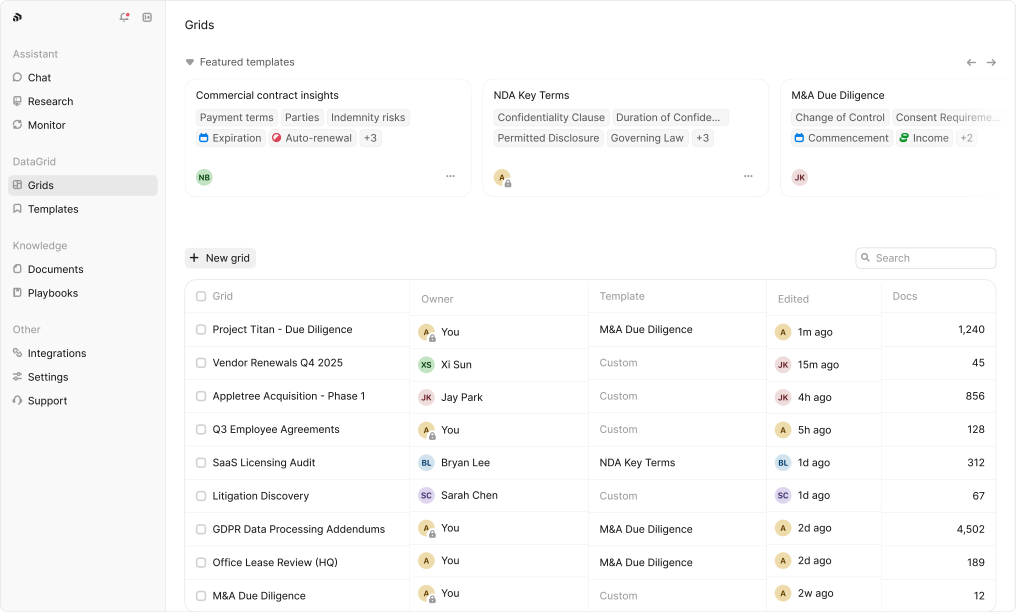
Volume is the reason DataGrid exists: DataGrid turns unstructured data from contracts, emails, and other documents into a structured table for due diligence, vendor management, M&A, and internal investigations, not a workflow that tops out at a dozen documents. Upload the agreements, define what to extract, and DataGrid sorts it into columns the team can filter and export.
Every document becomes part of a living knowledge base, not a folder: Contract Lens turns stored agreements into something the team can question directly. Ask in plain language, get the answer back immediately, instead of opening documents one by one to find it.
Side-by-side comparison
Capability | Ruli | GC AI |
|---|---|---|
AI legal assistant (chat interface) | Yes (Assistant) | Yes |
AI prompting assistance | Yes — Magic Prompt | Yes |
Word plugin for in-context redlining | Yes (Word Extension) | Yes |
Company Profile, personalization of risk tolerance and responses | Yes | Yes |
Playbook creation and review | Yes | Yes |
Regulatory monitoring with curated sources | Yes (Monitor) | Partial — scheduled prompting research (no curated sources) |
Indexed US, UK, and EU legal sources | Yes — Ruli Legal Database | No, just U.S. |
Smart contract repository and search | Yes (Contract Lens) | No |
Tabular document review at scale (M&A / due diligence) | Yes (DataGrid) — supports up to 10K documents per analysis | Yes |
Structured two-week onboarding | Yes | Yes |
Team-level usage analytics for legal tasks | Yes | Yes |
ROI measurement built into pilot process | Yes | Yes |
When is Ruli the right legal AI platform for your in-house team?
Ruli is the stronger fit when:
Your legal team’s work spans contract redlining and intelligence, regulatory monitoring, research, and collaboration. You need one platform that covers all of it, not separate tools for each function.
Your team operates across US, UK, and EU jurisdictions. Research needs to stay grounded in primary legal sources in every jurisdiction.
You need proactive regulatory alerts mapped to your specific policies and contracts, flagged automatically before they become a problem, not findings you discover only after asking a question.
Your contracts need to live somewhere searchable. Pulling precedent or checking every auto-renewal clause across last year’s deals shouldn’t mean re-opening files one by one.
Your team needs document review at a real scale. Structured clause extraction across hundreds or thousands of documents for M&A diligence or contract analysis, without sending that work to outside counsel.
You are building a business case for the CFO and need customer-specific metrics from your pilot. Zahreen Ghaznavi’s team at Newsweek tracked 754 hours saved on a single M&A diligence project. That number came from real work, not an estimate.
You want a vendor who stays involved through onboarding and beyond. Nilay Choksi, GC at Worksport, evaluated 12 to 14 legal AI tools before choosing Ruli: “It wasn’t just to make the sale, but also to keep the customer happy.”
When GC AI may be the right fit
If your organization is at the earliest stage of legal AI adoption — one or two lawyers who want to test AI for general research and drafting before committing to a broader deployment — a fully self-serve free trial may feel like a lower-commitment first step. Ruli’s pilot is designed for teams ready to measure impact from the start. If that is not where your organization is today, it may be worth waiting until it is.
The bottom line
In-house legal teams don’t need another AI chat tool. They need one platform the whole team trusts, one that holds up across complexity and jurisdictions: contracts, research, regulatory changes, business questions at 5pm before a board meeting.
Ruli is built for that team. Not for the law firm managing hundreds of clients, and not a library of prompts you have to pick and run correctly each time. For the lean in-house team that needs to move fast, stay current with every regulatory change, understand what you’ve agreed to before, and show up as a strategic partner to the business, without adding headcount.
“If I could not use Ruli tomorrow, you’re going to see us consulting outside counsel more. That comfortableness we have with the tool would disappear.” — Zahreen Ghaznavi, General Counsel at Newsweek
For a lean team at a global media company, that’s what the tool becoming indispensable actually looks like.
See how Ruli works across your team’s actual workflows, starting with the work already on your desk.
Related resources

Guidebooks
The Business Case for Legal AI
The four ways in-house teams measure the value of legal AI, backed by real numbers from real customers.
1 min read
Download

Guidebooks
Procurement to Proof
Scaling legal AI for impact — and getting credit for it
1 min read
Download

Guidebooks
Defensible by Design
A practical system for safely scaling AI across the in-house legal function.
1 min read
Download