AI changes the rules between in-house and outside counsel
John Lee, GC & Head of Strategy
Most legal AI is sold to a persona called “the lawyer.” The same demo runs for a general counsel and a litigation partner, the same time-saved-per-document metric closes both deals, and the roadmap treats two very different buyers as one market. I work in this category, and the criticism includes my own company.
The assumption underneath is that in-house and firm lawyers do the same work at different addresses. They do not, and that difference explains more about where AI lands in this profession than any capability benchmark does.
A tool tuned for exhaustive issue-spotting buries in-house counsel in flags nobody was ever going to act on. A tool tuned for fast triage strips out the tail risk that was the entire reason a firm got retained. The same contract, reviewed well by each, should produce two different work products, because each is aiming at something different.
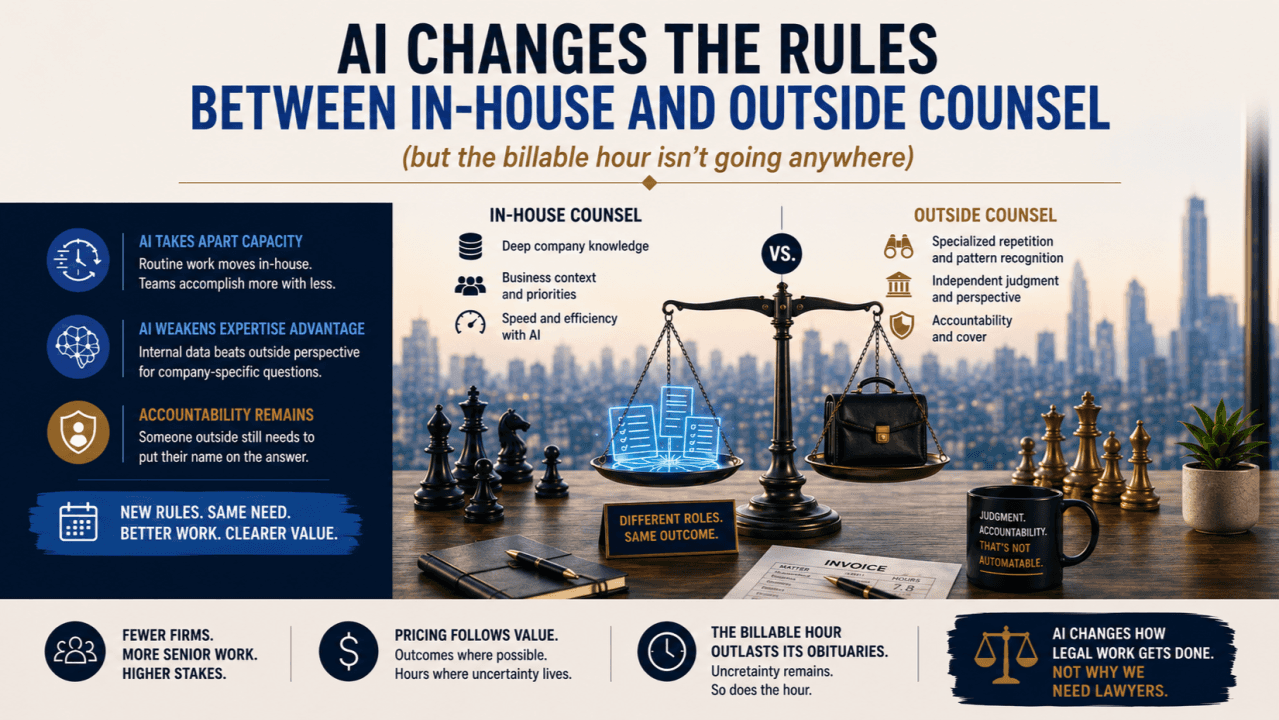
Legal work leaves the building for three reasons: the department does not have the hours, the law firm has the expertise from seeing the issue two hundred times before, and somebody outside the company needs to put their name on the answer. AI takes apart the first two and leaves the third completely intact. Most predictions about law firm decline only count the first two, which is why they overshoot. The relationship re-prices around the one asymmetry software cannot touch, and the work that survives is worth more per hour than the work it replaces.
The old bargain rested on scarcity
The billable hour was the price of capacity. The leverage pyramid, with junior associates grinding through volume work under partner supervision, was how firms turned that capacity into profit. Both arrangements assumed that legal analysis was expensive because human attention was scarce, and both lose force as that assumption weakens.
What crosses back over the line
First drafts, routine third-party paper review, standard research memos, diligence triage, and precedent searching are moving in-house fastest, because each one rewards pattern matching over judgment. A three-person department can now operate at something close to the capacity of an eight-person department from five years ago.
The more interesting shift is in who knows more. A department with a working contract repository knows its own deal history better than any firm ever did, including the firm that papered half of it. The firm’s pattern library still wins on market questions, like what other companies are accepting this quarter or where a regulator seems to be heading. On company-specific questions, which is most questions most days, the knowledge advantage has flipped to the client.
What stays out, and why it gets more valuable
AI does not carry errors and omissions coverage. It does not appear before a regulator, and it cannot give an audit committee the independent validation an auditor will accept. When a matter goes out for those reasons, the sign-off is the product and the hours were only ever the delivery mechanism.
Some legal work has always been bought for accountability rather than expertise, and that demand grows more durable as AI spreads, because the volume of machine-assisted output needing a human name attached keeps rising. Novel questions, adversarial posture, and genuinely high-variance matters stay outside for the same reason they always did.
The compression conversation neither side wants
When a forty-hour task becomes a four-hour task, someone captures the other thirty-six hours. Fixed fees, subscriptions, capacity retainers, and outcome-linked pricing are all attempts to answer that question before the client asks it directly.
Clients are getting better at asking. Panel benchmarking, AI-use disclosure in engagement terms, and invoice review run by software all lead to the same exchange: six hours billed for work a tool finished in six minutes. Firms that set their pricing model before that conversation happens will do better than firms that respond to it.
Outside counsel guidelines become the control surface
Outside counsel guidelines are turning into the main governance document of the relationship, covering permitted and prohibited tools, approval workflows, data residency, and terms barring vendors from training on client data. Most guidelines written before 2024 say nothing useful about any of it.
The distinction that decides how this plays out in a dispute is whether AI use is governed or ad hoc. A system-supervised workflow leaves a record of what the model produced, who reviewed it, and when. A lawyer pasting a clause into a consumer chat tool leaves nothing behind to point at. Same underlying technology, opposite posture when privilege or work product gets challenged, which is why the governance layer matters more than the tool selection.
ABA Formal Opinion 512 and its state analogs frame this as familiar duties applied to new facts: competence, confidentiality, reasonable fees, and supervision. Both sides of the relationship are subject to all four, which raises a symmetry problem. A number of departments now impose AI restrictions on their firms that they do not come close to meeting internally.
The playbook becomes the contract
Codified standards are replacing hallway instruction and tribal knowledge as the interface between a department and its firms. The playbook stops being an internal reference document and becomes the specification a firm works against, which changes what a firm can sell. Some firms will make more money authoring and maintaining a client’s playbook than they ever made working through it.
Deviation analysis runs in both directions now. A department can measure returned work product against its own repository at scale, so the quality conversation stops being anecdotal and starts being evidentiary. Shared systems raise the question neither side has answered yet: when a firm works inside a client’s platform, who owns the resulting data and the learning built on it.
What each side should do now
In-house counsel should audit what currently goes out and sort each matter by the real reason: capacity, expertise, or cover. Capacity work is the first to come back. In-house counsel should also rewrite the guidelines before a matter forces the issue, and measure returned work product against the repository, because that data already exists and almost nobody uses it.
Outside counsel should price outcomes instead of hours where the work has compressed, sell judgment and accountability plainly rather than burying them in a rate card, and consider building the client’s system instead of competing with it.
Both sides should settle one question early: whether AI use is disclosed, permitted, expected, or required. Left alone, the answer gets set by whoever gets audited first.
Fewer firms, and the billable hour survives anyway
Panel consolidation is the leading indicator to watch. If AI were only making legal work cheaper, departments would spread work across more firms and shop the savings. The early pattern runs the other way, toward fewer strategic firms doing more senior work at higher rates while routine volume moves inside.
The opening argument deserves one refinement. Expertise turns out to have two forms. One is knowing how to answer a question, which AI increasingly provides. The other is having answered that question a hundred times in live transactions, investigations, and disputes. Lawyers accumulate the second kind through exposure, and inference does not substitute.
That distinction is why specialization survives. Most companies cannot generate the repetition internally because the matters that require it arrive in bursts. A mid-size company might run one significant acquisition every two years and one serious dispute every three, nowhere near enough to build real fluency in either, and no repository fixes a frequency problem. The partner who has closed forty deals in the last eighteen months knows things that never make it into a document: which diligence findings actually move price, how a particular banker behaves in week six, what opposing counsel will trade when the timeline slips. Firms exist because they aggregate that repetition across hundreds of clients, encountering continuously what any single company meets once every few years.
Repetition also compounds, which makes the gap structural. Each matter sharpens how a specialist reads the next one, so the distance between a lawyer who handles something twice a year and one who handles it twice a week widens over time instead of holding steady, because information was never the scarce input and repetition still is.
Firm lawyers and in-house lawyers do different jobs
The deeper reason substitution fails is that the two roles produce different outputs. A firm is retained to be exacting. Its product is a thoroughly researched set of options with the risk of each one laid out, and the decision belongs to the client. In-house counsel takes those options and does the thing no firm can do from outside, which is weigh them against what the business needs this quarter and choose. That regularly means accepting a term the firm flagged, declining to enforce a right the company clearly holds, or signing on Friday with a known exposure because the alternative is not signing at all.
A firm cannot make the business tradeoff because it does not bear the business consequence. In-house counsel cannot accumulate the firm’s repetition because the work does not occur often enough. AI changes neither constraint.
Neither job is a lesser version of the other. AI keeps getting better at producing legal analysis, and it has nothing to say about what the company is willing to live with.
The billable hour outlasts its obituaries
Alternative fees require predictable scope, and the most valuable matters are the least predictable. Nobody can price the indemnity that never gets invoked, the cap that matters four years after signing, or the lawsuit that never gets filed because the contract was drafted well. Hours remain an imperfect measure that keeps outlasting better measures neither side can commit to in advance.
AI removed one reason for sending work outside almost entirely, substantially weakened another, and left the third untouched, which is enough to change how legal services are produced, priced, and staffed without changing why companies hire firms or what in-house counsel is actually for. The likely result is fewer firms on fewer panels, billing higher rates for a narrower band of matters where judgment, specialization, and accountability stay scarce.
The testable version of that claim is hiring. If this argument holds, first-year associate class sizes at the AmLaw 50 keep shrinking through the end of the decade while partner rates keep climbing, and both numbers holding steady means this was another cycle of noise.
The mistake is treating “the lawyer” as the customer. The legal market has never worked that way, and AI will make lawyers faster without making in-house counsel and outside counsel the same job.