So You Want to Be a Legal Engineer: A Field Guide for Lawyers Considering the Pivot
John Lee, Legal + Strategy @ Ruli AI
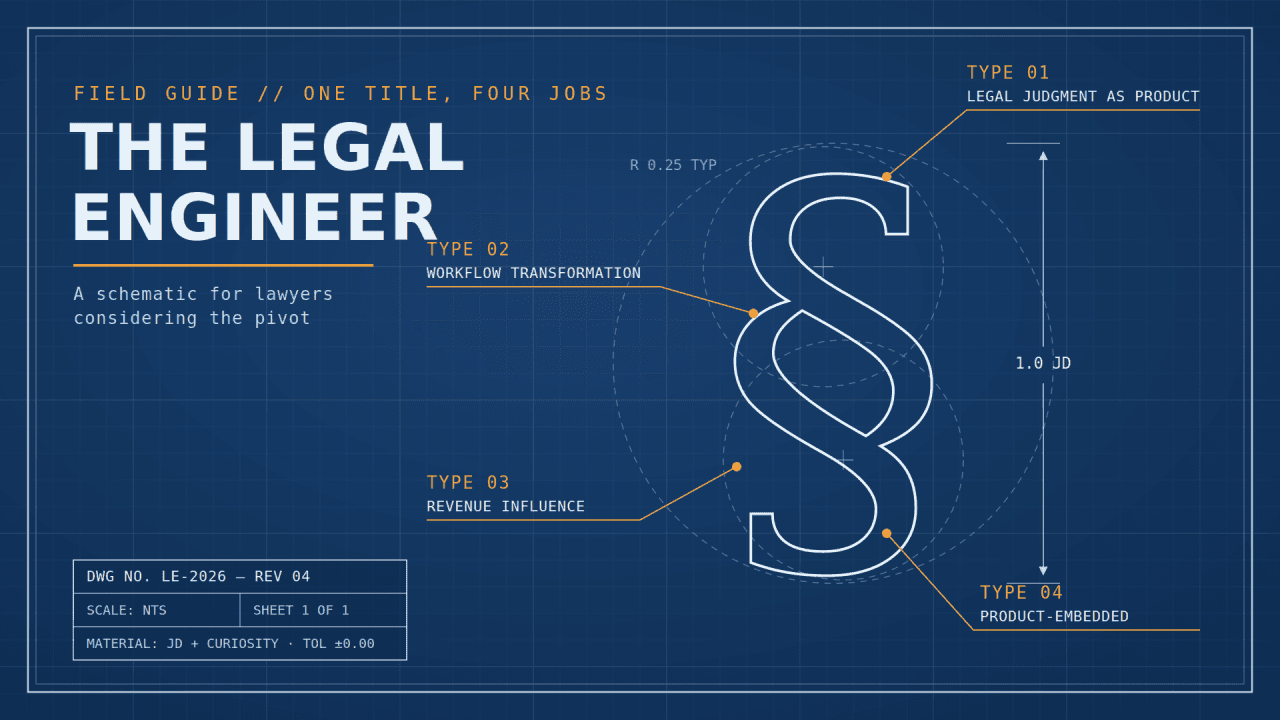
"Legal engineer" is one of the fastest-growing titles in legal AI — and one of the least standardized. Vendors, law firms, and in-house departments all use it, often to describe jobs that have almost nothing in common. If you're a lawyer eyeing one of these roles as a pivot out of practice, the title will tell you very little. The job description, the success criteria, and the org chart will tell you almost everything.
Here's a map of what these roles actually are, and what it takes to succeed in each.
First, a definitional caveat
The mainstream definition of legal engineering that you'll find from vendors and industry commentators is roughly: someone who sits at the intersection of law, technology, and process design, translating legal requirements into systems, workflows, and tools. Notably, a law degree is common but not required; some strong legal engineers come from product management, software, or operations backgrounds. This article is written for lawyers considering the role, but keep in mind you'll be competing with, and working alongside, people who took very different paths in.
Within that broad definition, the actual jobs cluster into a few distinct types.
Type 1: The lawyer whose legal judgment, enhanced with using AI tools, is the product
Some roles labeled "legal engineer" are, functionally, lawyer jobs. You're delivering legal analysis - encoding regulatory interpretations into a product's knowledge base, resolving substantive legal questions that surface during customer deployments, or delivering legal services outright inside an AI-powered law firm or ALSP. What the employer is buying from you is legal judgment, applied to legal questions.
There's nothing wrong with this work, but be clear-eyed about what it is: it's practicing law in a different wrapper, with little actual engineering. If you take this role expecting to build systems, you may be disappointed. And in the AI law firm variant, understand the economics - you may be delivering legal services at price points subsidized by venture capital, with compensation to match.
One important distinction before moving on: don't confuse this type with the implementation and adoption roles described next. From the outside they can look similar - both put lawyers at tech companies, often interacting with customers. But the industry treats them as fundamentally different jobs, and it's right to. In Type 1, you're answering legal questions. In Type 2, you're not giving legal advice at all - you're working on how legal work gets done. Lawyers evaluating these roles often collapse the two into "lawyer at a legal AI company." The people doing these jobs will tell you the day-to-day has almost nothing in common.
What's needed to succeed: Strong substantive expertise, comfort with ambiguity about what the job is, and honest self-assessment about whether "lawyer, but at a startup law practice" is actually the change you're looking for.
Type 2: The workflow transformation role
This is the center of gravity for the title today - when vendors, firms, and industry commentators say "legal engineer" without qualification, this is usually what they mean. And it is emphatically not a lawyer job: legal engineers in this mold don't give legal advice, and the value they add isn't legal judgment. It's the ability to sit at the intersection of law, technology, and process design - to understand a legal workflow deeply enough to rebuild it.
It splits into two variants:
Internal: Employed by a firm or legal department to drive process change - mapping workflows, configuring tools, building automations, driving adoption. The distinguishing feature is hands-on construction: you're not writing requirements docs and handing them to IT. You map the workflow, build the solution, and own the outcome.
External (vendor-side): Employed by a legal AI company to drive transformation at customers - deployment, configuration, enablement, training champions, tailoring the product to each customer's workflows. Vendors increasingly treat this as a distinct discipline, closer to structured change management than traditional SaaS solutions consulting: the hard part isn't installing software, it's getting a partnership or legal department full of skeptics with wildly varying comfort levels to actually change how they work.
What's needed to succeed: Process thinking, genuine hands-on tool fluency (no-code/low-code platforms, automation tools, AI systems - you don't need to write production code, but you need to be the person who opens an unfamiliar system and figures it out), and translation skills. You're constantly converting between how lawyers think and how systems work, and persuading skeptical practitioners to change how they operate. The lawyer's instinct to interrogate a system and hunt for edge cases translates well - if you can redirect it from contracts to workflows.
A necessary detour: the legal ops question
If Type 2 sounds a lot like legal operations, you're paying attention. The overlap isn't incidental - Legal engineering grew out of the same efficiency push that created legal ops in the first place: starting in the early 2000s, legal departments began demanding faster, more transparent, more cost-conscious service delivery, and tools like document automation, CLM, and AI-powered research created room for people who could connect legal knowledge with systems thinking.
Legal ops started as a function about running the legal team - vendor management, matter tracking, budget control. But the remit has been drifting for years. Scope started touching tools. Then connecting them. Then owning solutions end-to-end. A credible school of thought holds that legal engineering is simply where legal ops was always heading - that if you're in legal ops today and you're mapping workflows and building solutions yourself, you're already doing the job, whatever your title says.
Where's the line, then? The most useful test is the builder threshold. Legal ops, classically, can operate at the level of process and vendor selection: identify the problem, scope the requirement, buy or commission the solution. Legal engineering requires getting your hands dirty - you personally mapped the broken workflow, you personally built the fix, and you own whether it works. Using AI to augment your own output doesn't clear the bar either; the question is whether you designed something that works without you in the room, with edge cases, handoffs, failure states, and adoption all thought through.
Two practical implications for lawyers considering the pivot. First, legal ops is the most realistic on-ramp into legal engineering for a practicing lawyer without vendor experience - it gets you proximity to the tools, the workflows, and the pain points, and the transition from there is a shift in emphasis rather than a leap. Second, when you're searching for these roles, don't search by one title. The same job is posted as legal engineer, legal ops engineer, legal technologist, solutions engineer, or innovation counsel, and hiring managers are still figuring out what to call it. Read the responsibilities, not the label.
Type 3: The revenue role wearing an engineering title
Here's the critical decoder: some roles carry the "legal engineer" title but are measured on revenue. If your success depends on your work being attributed to a specific revenue number - pipeline generated, deals influenced, quota attained - you are not in a workflow transformation role, whatever the title says. You are in a revenue influence role, and your legal background is primarily there to provide credibility with legal buyers.
This is not a knock. Revenue roles can be rewarding, offer real autonomy if you perform, and often come with better lifestyle flexibility than practice. But they're a fundamentally different job with a fundamentally different temperament requirement, and they're not a fit for most lawyers. Know which one you're interviewing for.
What's needed to succeed: Comfort with short-term performance pressure, genuine enjoyment of persuasion, and resilience. If the idea of a number over your head makes you anxious, this isn't your pivot.
Type 4: The product-embedded legal engineer
The rarest type: a lawyer working directly with product and engineering teams to design and test legal AI itself - making sure features reflect real legal use cases, stress-testing outputs against the standard of care, encoding legal reasoning into product behavior. Companies need far fewer of these than implementation or GTM hires, which is exactly why the roles are scarce.
Like sales, many lawyers assume they can do this. Few are actually good at it. Substantive seniority helps - you generally need enough experience to know legal concepts and workflows inside and out. But expertise alone doesn't translate. You can be as smart and hardworking as anyone; if your relationship to the law is "here are the rules, I apply them," it won't carry over.
What's needed to succeed: The differentiator is a particular cast of mind. The lawyers who thrive here are drawn to law because of how it functions - as the rules governing how people interact and how society organizes itself - and their curiosity extends well past the legal industry: how technologies actually work, fundamentals of math and science, why things are built the way they are. You need to think in systems, tolerate iteration and failure, and be comfortable that your output is a product behavior, not a memo. If you're a partner or GC who also happens to enjoy quantum physics and logic puzzles, this may be your job. If that sentence made you wince, it probably isn't.
How to evaluate any specific role
Ignore the title. Then ask every interviewer:
What is this job meant to solve for? How is success measured - adoption and transformation outcomes, or revenue attribution? Who do I report to, and where does the function sit (product, customer success, sales, ops)? What did the last person in this role spend their time doing? Will I be building things myself, or specifying things for others to build?
The answers will sort the role into one of the four types above far more reliably than anything in the posting.
The bottom line
There is no wrong path here. Legal tech, AI, and ALSPs have created more optionality for lawyers than at any point in the profession's history, and every type above is a legitimate career. The failure mode isn't picking the "wrong" type - it's taking a Type 3 job while believing it's a Type 4, or expecting to build systems and finding yourself practicing law with a different email domain. Read the success criteria. Ask the uncomfortable questions. Then choose the job that matches what you actually want to do all day.